Digiwhiz Blog Hub

Explore expert tips and industry trends on website, digital marketing and mobile apps categories.

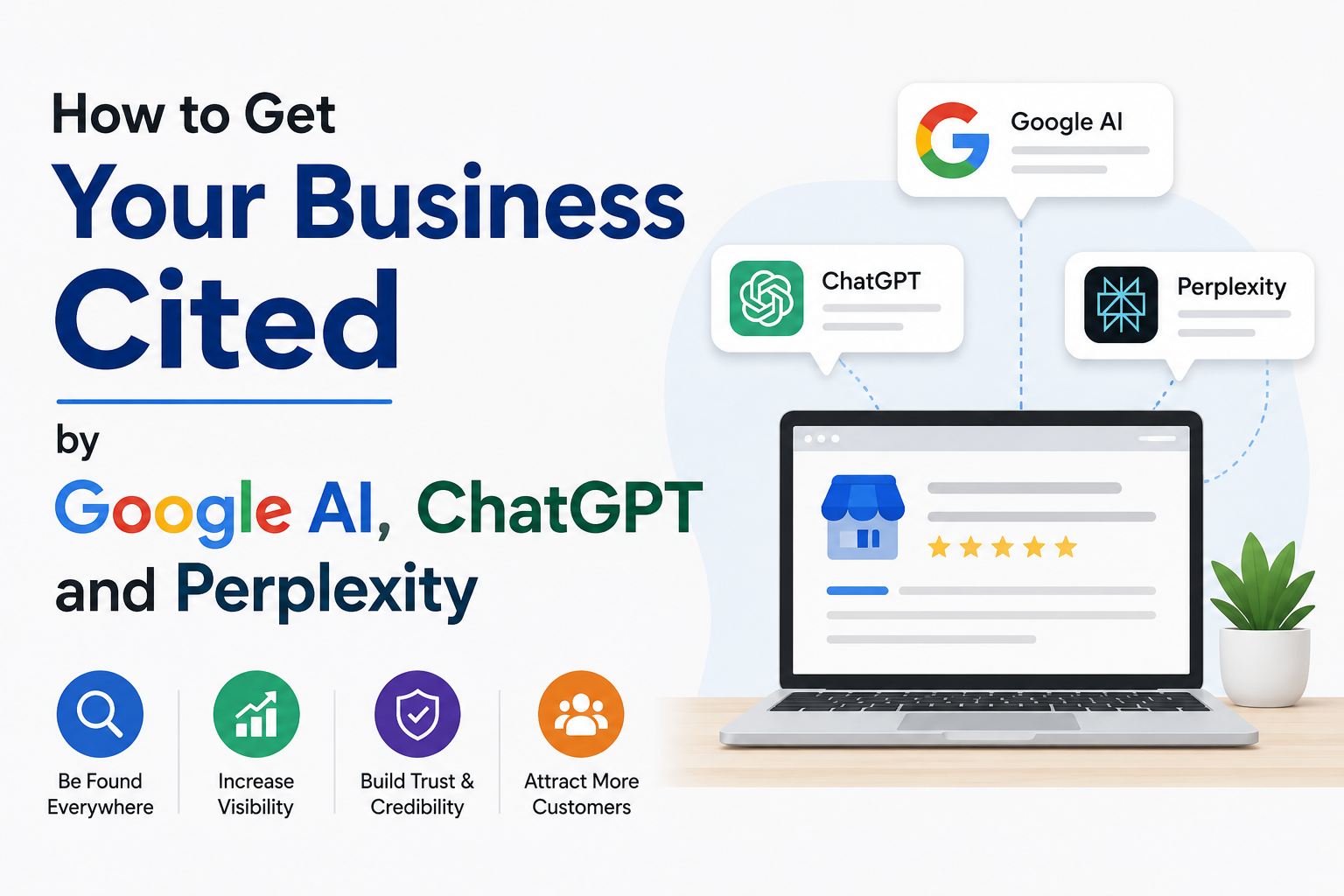
How to Get Your Business Cited by Google AI, ChatGPT and Perplexity

Digital Marketing

July 27, 2026

How to Get Your Business Cited by Google AI, ChatGPT and Perplexity

The way your customers find you is changing faster than most Melbourne businesses realise. According to Roy Morgan's March 2026 survey, 58 per cent of Australians aged 14 and older used AI tools in any four-week period during Q1 2026 — that is 13.6 million people. And crucially, 12 per cent of Australians now identify AI tools as their primary way of finding information online, up from 5 per cent just twelve months ago. One in eight of your potential customers may have already formed an opinion about your business based on what an AI tool told them, before they ever visited your website.

AEO services: Answer Engine Optimisation is the discipline that determines whether your business appears in those AI-generated answers. At Digiwhiz, we have been building AEO and GEO (Generative Engine Optimisation) signals into our clients' content and technical setups for the past 18 months, and we are now offering this as a standalone service for Melbourne and Australian businesses. In this blog, we'll cover what AEO is and how it differs from SEO, the five signals that determine AI citation, the specific steps to optimise for Google AI Overviews, ChatGPT, and Perplexity, and how to measure whether it is working.

What Is AEO and How Is It Different from Traditional SEO?

AEO stands for Answer Engine Optimisation. It is the practice of structuring your content, data, and digital presence so that AI-powered platforms can understand your business accurately, trust it enough to cite it, and surface it when users ask relevant questions.

Traditional SEO is about ranking in Google's organic search results. You target keywords, build backlinks, optimise page speed, and climb the blue-link rankings over time. AEO operates on a different logic. AI platforms do not return ten blue links. Google AI Overviews, ChatGPT, and Perplexity return one answer, or a small set of cited sources. The business that gets cited is not necessarily the one ranking number one in traditional search — it is the one whose content is most clearly structured, most factually specific, and most trusted by the AI model's training and retrieval signals.

The two strategies are complementary, not competing. Strong SEO content that is well-structured, specific, and authoritative tends to perform well in both traditional search and AI citation. But AEO requires specific technical and content elements that traditional SEO does not address, and missing them means your business is invisible in the AI answers your customers are increasingly relying on.

5 Signals That Determine Whether AI Cites Your Business

These are the five core signals that AEO strategy works to build and reinforce.

1. Entity Clarity - AI Needs to Know Exactly Who You Are

AI models build their understanding of your business from structured signals across the web. Your business name, address, phone number, category, and services need to be consistent and clearly structured everywhere they appear: your website, Google Business Profile, Australian business directories, social media profiles, and any media mentions. Inconsistent entity data - different phone numbers across listings, slightly different business name variations, vague service descriptions - makes it harder for AI to confidently identify and recommend you.

2. Structured Data Markup - Schema Is the Language AI Reads

Schema markup is the code layer that tells AI systems directly what your business is, what it offers, where it operates, and what customers say about it. The most critical schema types for Australian businesses are LocalBusiness (or the relevant sub-type for your industry), FAQPage, Service, and Review. Google AI Overviews and Bing Copilot actively use schema to extract information for their answers. Perplexity and ChatGPT use the structured information on your site alongside external sources to build their understanding. Without schema, AI is making inferences rather than reading clear signals - and inferences get you cited less often.

3. Answer-First Content - Structured for Extraction

AI citation engines pull the most direct, most specific answer to the question being asked. Content structured as answer-first paragraphs - a clear direct answer in the first sentence, followed by supporting context - is significantly more likely to be extracted than content that buries the answer in the middle of a long paragraph or uses vague generalisations.

This is why the FAQ structure that has been part of good SEO practice for years matters more than ever in 2026. FAQPage schema combined with answer-first paragraph structure is the most reliable way to build AI snippet eligibility. Every FAQ answer on your website should lead with a single, extractable sentence before expanding.

4. Citation Authority - AI Trusts Sources That Others Trust

AI models are trained on, and retrieve from, sources that are already considered authoritative. A business that is mentioned in reputable industry publications, has a Google Business Profile with strong reviews, is listed in credible Australian directories, and has earned backlinks from trusted websites is treated as more citable than a business whose digital presence is limited to its own website. Building the citation footprint that makes AI trust your business requires consistent digital PR, review management, and structured off-page authority signals.

5. Freshness and Factual Accuracy - Outdated Content Gets Skipped

AI retrieval systems favour current, accurate content. Pages with outdated statistics, outdated pricing, or claims that contradict other sources about your business will underperform in AI citation. For Melbourne service businesses, this means keeping service pages, pricing information, and blog content current and verifiable. Claims that cannot be sourced or verified - vague superlatives, unconfirmed statistics - actively reduce citation probability compared to specific, verifiable facts.

How to Optimise Specifically for Google AI Overviews

Google AI Overviews now appear on a significant share of Australian search queries. Zero-click searches accounted for approximately 58 per cent of all searches in Australia in 2026, up from 51 per cent in 2023, driven significantly by AI Overviews and featured snippets reducing organic click-through rates.

To improve your probability of appearing in Google AI Overviews, the most direct actions are implementing FAQPage schema on every page with a FAQ section, structuring all body paragraphs to lead with the answer rather than the context, ensuring your LocalBusiness or business-type schema is accurate and complete, and targeting informational search queries in your blog content that map to questions your customers actually ask.

Google's AI Overviews draw primarily from sites that already rank in the top ten for a query. This means AEO for Google AI Overviews is not entirely separable from traditional SEO - you need the ranking foundation first, and the AEO structure on top of it.

How to Get Cited by ChatGPT and Perplexity

ChatGPT and Perplexity operate differently from Google AI Overviews. They are retrieval-augmented systems that pull from their training data and from real-time web retrieval, depending on the platform mode and query type. For Australian businesses, the most relevant optimisation approach is:

Publish content that directly answers the questions your target customers ask these platforms. Think about the queries: "best digital marketing agency in Melbourne", "who does Shopify development in Melbourne", "what is AEO and how does it work in Australia." If you have clear, specific, well-structured content that answers these questions better than your competitors, you are building citation probability over time.

Earn mentions in sources that AI models treat as authoritative - industry publications, Australian business media, credible review platforms (Google Reviews, Clutch), and notable web directories. Perplexity's citation model heavily weights sources that appear across multiple independent references. A single well-linked page on your own site is less valuable than consistent mentions across five credible external sources.

Implement an llms.txt file on your website - a plain-text file that tells AI crawlers explicitly what your business does and how it wants to be described. This is an emerging standard that several AEO-forward agencies are now implementing for clients.

How Do You Measure Whether AEO Is Working?

Traditional search ranking reports do not capture AI citation. To measure AEO performance, you need a separate reporting layer.

The most practical approach for a Melbourne small business is monthly manual prompt auditing: run your target queries through ChatGPT, Google AI, and Perplexity, and record whether your business is cited, mentioned, or absent. Track this as a share-of-voice metric over time. Tools like DataForSEO's AI visibility data and HubSpot's AI Search Grader are emerging as more scalable options for businesses with larger query sets.

At Digiwhiz, our SEO services now include AI visibility tracking as a reporting layer alongside traditional organic search performance. This gives clients a complete picture of where they appear across both traditional and AI-driven search channels.

Why Choose Digiwhiz for AEO Services in Melbourne?

Most Melbourne digital agencies are still building traditional SEO strategies and treating AI search as a future concern. Digiwhiz has been integrating AEO and GEO signals into client work for 18 months, which means the businesses we work with are already building the citation authority that competitors have not started on yet.

We are based in Moorabbin, Victoria, with 12 years of experience and more than 500 completed projects. We are an official Google Partner. Our approach to AEO is not a separate product layered on top of your SEO - it is built into everything we do, because the content and technical signals that make Google trust your website are the same signals that make AI platforms cite it.

Find out how we work and what building an AI-visible presence for your Melbourne business looks like in practice.

Key Takeaways

Answer Engine Optimisation is the discipline of getting your business cited by AI platforms like Google AI Overviews, ChatGPT, and Perplexity. With 58 per cent of Australians using AI tools monthly and 12 per cent using them as their primary information source, AI citation is no longer a future concern - it is a current acquisition channel. The five core signals are entity clarity, schema markup, answer-first content structure, citation authority from external sources, and content freshness. Optimising for Google AI Overviews requires combining traditional SEO ranking with AEO structure. ChatGPT and Perplexity citation requires building authority across multiple independent external sources alongside your own structured content. Measuring AEO requires manual prompt auditing and AI-specific tracking tools, not traditional keyword rank reports.

Want to Know How Your Business Currently Appears in AI Search?

The first step is an AI visibility audit: we run your target queries through ChatGPT, Google AI, and Perplexity, document where you appear and where competitors are getting cited instead, and identify the specific gaps in your current setup. There is no obligation after the audit.

Call Digiwhiz on +61 3 9935 6356 or book your free AI visibility audit.


Top Link Building Strategies That Will Work In 2024

Digital Marketing

December 22, 2023

Top Link Building Strategies That Will Work In 2024

It’s true that SEO is all about link-building. Yet, modern backlinking isn’t easy. Further, the world of digital marketing is ever-changing. This means what worked a year back won’t get you the desired results today.

But one thing that remains unchanged is the importance of backlinks or link building. It is still the best way to rank higher on Google search results and build authority for your business. That’s why businesses should focus on getting high-quality SEO backlinks even in 2024. But, they need to enhance their link building strategies to gain desired results.

Scope of Backlinks in 2024

The latest poll by Barry Schwartz of Search Engine Roundtable revealed a shocking report. It shows that a large number of marketers no more believe in the usefulness of backlinks as before. But, in reality, that’s not true.

Today, Google no longer focuses on quantity but on the quality of backlinks. This means having a lot many backlinks will no longer boost your website’s ranking. Rather, you must now get high-quality links from reputable sources.

With artificial intelligence (AI) and machine learning, search algorithms have become smarter. This makes it easier for them to differentiate and penalise low-quality backlinks. So, websites that use unethical link-building strategies to earn more backlinks are at great risk. They might damage their ranking instead of improving it.

Instead, marketers should focus on earning natural, organic backlinks from creditable sources. Creating high-quality, relevant content will maximise the benefits of backlinks. Moreover, search engines will not consider penalising their websites.

Best Link Building Strategies To Use In 2024

Top seo services Melbourne companies suggest some effective, organic link-building strategies. Using these strategies can help you receive high-quality backlinks organically.

  • Backlink Hunting in Competitor Profiles

Building links yourself can be quite difficult. But there’s an easy way to do it - spying on your competitor's backlink profiles.

Highly successful websites already have a strong link-building foundation. Their backlink profiles have many competitors' domains. These domains are keen on websites similar to theirs and yours.

Use your preferred SEO tools to search for your competitor's domain. Access their backlink profile overview, number of domains, and other relevant information. Focus on the referring domains and identify the ones that are pertinent to your website. Check the URL source of each domain and see if you can feature your website in the same source.

By reaching out to the source, you may be able to get a link. Or, you may only collect some domains to target for content marketing or outreach.

  • Fix Broken Links

Fixing broken backlinks directed to your website is an effective link-building strategy. These are links that were before directed to your site but may now be broken due to a removed page or a technical error.

To fix these broken links, you can use a good SEO tool designed for broken link building. Once you have found the broken links, reach out to the relevant domain. Request them to restore the link to your website or fix the original source. You can offer them something of value in exchange for a backlink.

Often, this can be a simple oversight that can be easily resolved. They will re-add your link to the original source or a new source.

  • Convert Unlinked Brand Mentions Into Backlinks

For getting a backlink, another website needs to mention your site. Sometimes, a brand might mention your site but forget to link back to it. You can take advantage of these unlinked mentions to build links.

The good news is that you don't have to do much work for this strategy. That's why it's one of the simplest ways to build links. All you have to do is contact the person who can edit the page and ask them to add a link.

Note that a mention is not limited to words alone. If someone uses an image from your website, count it as a mention too. If you discover someone has used your images, you can convert them into backlinks using the same method. Simply use Google to search for your original images and find out who is using them.

  • Generate Unique Sources of Valuable Data

You have probably heard the phrases "content is king" and "make high-quality content" many times before. But what kind of content do you need to create if your goal is to get backlinks?

Any content can attract links if it reaches the right audience. But some types of content are more likely to receive links than others. They include surveys, graphs, infographics, research results, and case studies.

The key is: Anything that contains valuable information can attract links.

Statistics and percentages are popular to cite in content. Ever searched for a source on Google to include numbers in your content? After finding the source, what did you do next? You added a link to it.

If you can create this type of content for your website, people will likely cite you. This is especially true if you have rare data and are considered an expert. It can be difficult, but it's worth the effort.

  • Update Your Content Regularly

Outdated content is a common issue. If you aim to create new and quality links regularly, you must keep your content up-to-date. Link building is more than just about making new links. It is the process of creating a strong link profile including:

  • Building new backlinks.
  • Eliminating spammy backlinks.
  • Maintaining or retaining good quality backlinks.

While you may have some great backlinks in your profile in the past, those sites may stop linking to you if they find better sources out there.

In fact, creating and offering better linkable content is one of the best-known link-building techniques. However, in this case, you could be on the losing side.

To avoid becoming the “loser” in this scenario, ensure your content is always in top condition. Add the most up-to-date and helpful information. That way, you will retain more backlinks and prevent your domain authority from dropping.

  • Go With The Trend

New trending topics emerge every day. These cover everything from world news and technology to pop culture and food. Trending topics present great opportunities to create engaging content that can attract links.

Google Trends is an excellent resource for finding and using these trending topics to create new content.

You can use the search engine to discover hot topics and turn them into blog posts. For example, you may use topics like "Best AI Devices For Your Business in 2024” or "Best Blockchain Platforms for Game Developers."

Creating content based on trending topics makes it more easily discoverable. Using the word "best" can make it more appealing. This combination can help you create content that captures people's attention, engages them, and earns links.

  • Share Your Expertise With Others

Are you confident in your skills and expertise? Is your brand’s name well-known in your community? If so, you should put your reputation and expertise to good use.

Find websites where you can add value through your input. Reach out to the content makers of those websites and:

  • Write guest articles.
  • Get published in online journals.
  • Give interviews.
  • Participate in podcasts.

These opportunities are excellent for building links. They consistently result in a backlink, often from a trustworthy source. You can also reach a wide audience in this way.

What's difficult is reaching a point where your opinion or statement holds significant influence. But, once reach there, creating backlinks becomes a lot easier.

The Takeaway

SEO backlinks are here to stay and will impact your search rankings undoubtedly. Hence, you must include a solid link-building strategy in your marketing plan to get quality backlinks.

To get backlinks naturally,

  • Focus on creating high-quality and relevant content that provides value to users.
  • Avoid using link-building schemes that search engines can detect and penalise.
  • Build relationships with other websites and experts in your industry.
  • Monitor your backlink profile regularly. This will ensure the quality of the websites linking to you and detect any spammy inbound links.
  • Find and work on broken link fixing and unlinked mentions.
  • Use tools like Google Search Console, Ahrefs, and Semrush to gain insights into your backlinks and anchor text.
  • Creating useful content is the best way to attract high-quality backlinks.
  • Don’t miss out on trending topics in your industry to seek maximum audience attention.

Overall, by following best practices and organic link-building strategies, you can earn natural, high-quality backlinks. If you still have issues, it’s a good idea to look for a reputed SEO services in Melbourne company near you. They will understand your business and accordingly,  build an impactful link-building strategy that works best for you.


8 Key Metrics to Track Website Performance in 2024

Digital Marketing

December 15, 2023

8 Key Metrics to Track Website Performance in 2024

Your website is the digital face of your business. It’s the first impression most of your online customers will have of your brand. And tracking your website’s performance is a great way to understand what your audience thinks about your brand.

But how do you track website performance? There are some key metrics for website performance offered by various reliable platforms. From organic traffic to bounce rates, keeping track of these metrics can navigate you through your growth journey in 2024 and beyond.

A top web designing company in Melbourne reveals eight web page performance metrics for a successful site in 2024.

Continue to read to know more.

Why is it Important to Track Website Performance?

With over 200 million active websites on the internet, it’s important to know where your website stands in the competition. Various website engagement metrics provide an understanding of how many users visit and their behaviour on your different web pages.

By analysing action plans and their results, you can determine if your strategies are working as planned. If they are not, you can take the required actions and optimise your web pages to drive visitors and achieve the conversion you’re aiming for.

Further, website metrics can also help you with:

  • Analysing the effectiveness of your content
  • Troubleshooting your customer experience
  • Target and address pain points.
  • Compare your site with that of your competitors.
  • Improving sales and finding more growth opportunities online.

In short, tracking website performance helps you know if your online marketing efforts are paying off. But to achieve all the above, it’s important to track the right website performance metrics.

So, how can you determine the right performance metrics for your website?

It’s quite simple!

List all the questions you want to answer about your question before you start looking at the metrics you plan to measure. For example, you might want to know:

  • Do you aim to improve traffic or conversions?
  • Do you want to focus on existing customers or drive new customers?
  • Are you interested in making improvements to your site or business growth?

Answering such questions can help you decide which metrics to focus on and the ones to ignore.

Key Website Performance Metrics to Watch Out For in 2024

Here’s a list of the top 8 site performance metrics that can help you improve your site and achieve your online marketing goals:

(1) Website Traffic:

There are different types of website traffic, including organic, direct, referral, paid and social. By understanding traffic types and website metrics associated with them, you can analyse and optimise all sources for improved conversions.

  • Organic Traffic
  • Sourced from search engines like Google, Yahoo, or Bing
  • Considered high-quality, as it includes no paid advertisements or promotions.
  • Means search engines recommend your content to visitors actively searching for information related to your business/industry.
  • Direct Traffic
  • Comes from typing a URL in the browser or clicking a bookmark
  • Considered high-quality, as users intentionally perform the search
  • Results of offline marketing efforts, such as radio or print, and social media campaigns for online brand awareness.
  • Provides insights into customer loyalty and brand awareness.
  • Referral Traffic
  • Visitors coming to a site from another website are considered referrals.
  • Results of off-site marketing, like guest posts and participating in social media community discussions.
  • Provides insights on new customers who might have just discovered your website.
  • Paid Traffic
  • Visitors visit your website as a result of paid ad campaigns on social media and other platforms.
  • Works well only if you have a comprehensive understanding of your target audience and the best ways to reach them.
  • Provides insights on new customers and keyword intent.
  • Social Traffic
  • Visitors come to your website from social media platforms like Twitter, Instagram, Facebook, LinkedIn, etc.
  • Helps you enhance brand awareness and reach new customers.

While organic traffic is the most important traffic metric, this also depends on your website’s goals and objectives. For example, for an e-commerce website, the most important traffic metrics would be direct and organic search traffic.

Best website performance metrics tool to track traffic: Google Analytics, Ahrefs Traffic Checker.

(2) Website Speed

This metric tells how quickly pages on your website load and render their content. This important metric determines your user experience and website performance. But if your website takes over 2 seconds to load, it can lead to low user engagement, higher bounce rates, and reduced conversions.

Just like users, search engines also like faster websites and consider them for higher ranking in search results.

Best tools to track page speed: Google PageSpeed Insights, GTmetrix, and Pingdom.

(3) Page Views

It measures the number of times a webpage is seen by a visitor. When a page on your website is loaded in the browser, it is recorded as a one page view. The count increases as many times a visitor loads and reloads the same page.

The page views metrics tell how popular your website is among users and how much traffic it is receiving. However, higher page views could also mean issues with your site, like low performance or poor navigation, which makes users reload it repeatedly.

So, when page views metric to assess your website performance, you should be clear in your context.

Best tools to track page views: Google Analytics, Kissmetrics

(4) Average Pages Per Visitor

This metric indicates user engagement and tells how users engage with your content. It depends on the purpose and content of your website and the audience. A higher average pages per visitor suggests they are finding your content engaging and interesting. So, this metric helps you measure the effectiveness of your content.

Also, a higher number of average page views can positively affect your revenue, as the more the visitors engage with your website, the more likely they will take any desired actions - buy or subscribe.

Best tools to track average pages per visitor: Google Analytics

(5) Bounce Rate

Refers to the number of users who are leaving your site soon after arriving. A high bounce rate can negatively affect conversions and overall performance. Further, it can serve as an indicator that your website isn’t delivering quality.

Best tools to track bounce rate: Google Analytics and Pingdom.

(6) Device Type

This metric measures the type of devices on which users access your website during a set period of time. It can help you improve user experience across various devices. This metric includes:

  • Number of visitors
  • Device type (mobile, tablet, desktop computer, Mac or PC)
  • Percentage of visitors per device.

Best tools to track device type: Google Analytics, Host-Tracker

(7) Conversion Rates

Tracking this metric helps you gain viability into your lead quality and how effective your website is as a whole. It is the number of visitors who convert on your website through filling out web forms, trial sign-ups, content downloads, or completed purchases.

Best tools to track conversion rates: Google Analytics, Hotjar, Hubspot

(8) Top Pages

It refers to web pages with the most page views or conversions. Such pages are the highest-value web pages on your site and can tell you what attracts your users the most. This information can be used to improve your website strategy.

Best tools to track top pages: Google PageSpeed Insights, GTmetrix, and Pingdom.

Conclusion

Having a well-performing website can do wonders for your business, getting you more customers and sales in the long run. Besides having the right strategy to develop your site, it is important to track website performance to ensure it is fulfilling what it is intended for. Use the above-listed metrics to track how your website performs and rework your strategy accordingly for continuous business success.


Why is Google My Business More Important?

Digital Marketing

December 4, 2023

Why is Google My Business More Important?

Do you own a brick-and-mortar business with no online presence? Do you sell your business online yet aren’t selling much? A strong online presence is a must for every business in today’s cut-throat competitive market. Of the several tools, Google My Business is one of the most powerful tools to boost your online presence.

The blog emphasises Google My Business importance and how you can leverage it as a business to your best.

What Is Google My Business?

Google My Business (GMB) is an efficient tool for business owners to manage their business profiles on Google and related websites. Businesses can create, verify and edit their brand listing in Google without doing any additional work on your website. With GMB, you can list your business on websites like Google Maps, Google Search, Local Search, and Mobile Search.

The best thing about GMB is that it’s entirely free. Further, if used correctly, it can help increase your revenue and get valuable insights about your customers.

Developed by Google, it aims to make online searchers' lives easier. They can get the information they need quickly, conveniently, and anytime.

Businesses can add their address, contact information, and opening hours to their Google My Business Profile. This saves searchers’ time visiting your website and looking for your information. Put simply, GMB is a way to allow users to find you more quickly and contact you.

As a business, Google My Business Profile is a one-stop solution for you. It prevents you from keeping up with a whole bunch of online real estate that needs your attention: your website, your Facebook, Twitter, Instagram, etc.

What Can You Do With GMB?

Google Business Profile allows businesses to bring in customers through a simple yet effective search mechanism. With GMB, you can:

  • Create and update your company profile at any time. All you need to do is visit Google My Business, create your business profile and edit it whenever required.
  • Display your offerings using attractive visuals. Add numerous engaging photos and videos of your products and services to attract potential customers.
  • Get in-depth insights into what GMB brings to your company. You can track website visits and calls, including many others.
  • Win customer interest by encouraging them to write their reviews. Businesses with positive reviews on their GMB profile can benefit from increased click-through and conversion rates.
  • Share your company’s latest offers through texts, photos or videos.
  • Increase gains for your business by regular Google My Business optimisation.

Let’s now dig deeper into Google My Business importance.

Importance of Google My Business (GMB)

Google My Business (GMB) is not an option but an essential part of any business's online presence. It’s today the first place customers look for the latest information about your company.

Here’s why most digital marketing agency Melbourne and across the world emphasise Google My Business importance.

  • Helps Your Website Rank Better

GMB profile is crucial for Local SEO as it allows your business listing to appear in specific local search results. Users can find your business through queries specific to your products or services. Further, queries with large search volumes show local results in the three-pack. This is something startups and small businesses can capitalise on.

  • Boosts Your SEO Effort

As GMB boosts your online visibility, it results in driving more customers to your business. It does this regardless of whether your business is online or a brick-and-mortar store.

Keeping your GMP up-to-date with location and other information makes it easier for customers to find you. Also, it offers you additional opportunities to be seen in the 'map pack', which shows potential customers where to find you.

  • Control Your Information and Offerings

Google My Business not just puts basic business information into Google’s local search index, but a lot more than that. It also offers a range of extra tools to help you entice and inform local customers.

For instance, you can add information like product lists, menus and prices, accepted payment types, and interactive photos and reviews. Further, you can also add special offers and coupons for your visitors.

In short, with GMB, you have complete control over what information you want to showcase to your audience and which you don't.

  • Manage, Display and Respond to Reviews

User Reviews are one of the most important elements of a Google My Business listing. Recently, Google started a campaign to recruit users as "local guides", rewarding them for rating and reviewing local businesses.

Top-quality, positive reviews will help you improve the online visibility of your business. It also increases the chances that a potential customer will visit your company.

  • Get To Know Your Customers Better

Knowing your customers, their likes, and their interests is crucial for businesses to grow and improve. The GMB platform offers many analytical options that businesses won't find anywhere. These options enable companies to know their customers more.

For example, you can access information on Google Maps, where requests for driving directions to your location originated from. You may use this information to target new customers in the area. You may also target a new suburb to expand into for your business growth.

Google My Business Optimisation

Optimising your GMB is essential if you want to leverage its benefits and prevent customer turnover. For instance, if you've changed your working hours, you must also immediately amend them in your GMB.

To make changes to your GMB account:

  • Sign in to your Google My Business profile.
  • Go to "Info" then "Edit."
  • Change your business hours for each day.
  • If you want to dedicate specific hours to certain types of services, add these under the “More hours” box.
  •  Click “Apply” once finished.

Note: When adjusting your business hours, make sure your GMB listing reflects the changes. This will allow you to have a reference in case a customer complains that you're not open at a specific time. Also, as you update the hours, GMB will notify your customers of the change via orange text in your GMB panel.

When optimising your GMB, change your business's description as well. You can do this by adding one or two lines about the amendments you are making as a business for your customers. Be specific.

For instance, if you have decided to accept only contactless payments, mention it. Further, if you've included a new service for a specific set of customers, mention that too.

Remember, GMB is a brilliant way to build trust with your users and mitigate concerns. As such, don't ruin the opportunity.

What's next? Periodically update your business's photos. For example, if you've changed your building's interior for any reason, have your photos reflect these changes. Let's say, you can include a photo of the new waiting area if you have any. Do not forget to delete the old ones.

Lastly, make sure you categorise your business properly for a better local ranking. In your GMB control panel, go to "Primary Category" and choose the category that best describes your business (i.e., "casual dining restaurant", or "marketing agency"), and add a secondary category if needed.

The Takeaway

Modern tools like Google My Business have changed the way businesses promote themselves today. The benefits that GMB offers are essential to business growth and success. Hence, ensure to have an up-to-date and detailed Google My Business page for your business. Because if you fail to do so, you're missing out on one of the best free ways of appearing in Google search results.

It just takes a little time and knowledge to optimise your GMB page, and you can see the benefits instantly. Still unsure about how to do it? Get in touch with the best digital marketing agency Melbourne and let them take care of your GMB profile creation, optimisation, and maintenance.


6 Local SEO Tips to Get Your Customers to Your Local Business Store

Digital Marketing

November 23, 2023

6 Local SEO Tips to Get Your Customers to Your Local Business Store

Searching Google to find a top-rated local store nearby is quite a part of our routine now. In fact, research reveals that over 97% of Australian consumers turn to the internet to find businesses in their area, with 86% using Google Maps for store recommendations and their routes.

So, if you are a local business, these numbers are an eye-opener for you to improve your local SEO game. This includes creating strategic content on Google search sites and achieving high online visibility when consumers shop on search engines.

In this blog, we have compiled a list of top local SEO tips 2024, as suggested by the top Local SEO company Melbourne. Incorporating these into your local SEO game plan can improve your local search visibility to a great extent.

Before you get to know the top local SEO tips, you should first understand why local SEO is important.

Why is local SEO important?

It’s simple! It enables you to bring your local customers to your store. With more and more people searching online for local businesses, having a strong online visibility is important. Businesses can achieve this by improving their local SEO strategies, which allow them to ensure their company appears as one of the top results when their consumers look for their products or services online.

And if you can get your local business in front of these online searches, there’s a good chance a large number of these searchers will walk to your door a few minutes later.

6 Powerful and Actionable Local SEO Tips to Dominate Your Local Market:

If you’ve been working on creating a strong local SEO strategy lately, here are the top 6 suggestions by our experts:

  • Establish and Keep Up With Your Local Presence Online:

Nothing goes beyond having a Google My Profile (GMB) when it comes to local SEO. And it’s not just about having a GMB profile; keeping it updated is equally important.

GMB is a powerful yet underrated tool that works by connecting businesses with their local people. When searchers go online looking for a service your business can offer, your listing will be active in both search and maps. As such, claiming your GMB profile and keeping it up to date is essential to the success of your local listing. Providing insufficient or incorrect information will decrease the trustworthiness of your business.

When it comes to GMB, Google Posts is a native tool that provides you with an opportunity to publish relevant and fresh content with insightful information about the local area. These focus on promoting engagement and genuine interactions with potential local customers.

You can further enhance your local visibility online by

  • Assigning additional categories to your locations.
  • Setting relevant local attributes defining your business's operations and characteristics.
  • Landing page optimisation to reference many of the attributes specified in the GMB listing.
  • Leverage Schema Markup:

It is a set of codes that improves how your web page gets represented in the search results.

Structured data, including schema markup, provides search engines with detailed insights into your business, products, and services. It is responsible for giving them GPS coordinates to your digital doorstep.

Incorporating schema markup to highlight essential local information, such as business hours, location details, and reviews, will ultimately improve your website ranking, which will boost your click-through rates.

  • Use Keywords With a Local Intent:

One key factor you can't overlook when working on local SEO is keyword intent. When it comes to choosing the right keywords for local SEO, the crucial question is this: "Who do I want visiting my website?"

Well, marketers should consider three types of SEO intent when planning for their local SEO campaign. Each category will provide details about the searcher, serving as the foundation for the information to be provided.

When it comes to local SEO keywords, these are usually linked with “transactional intent”. These are sometimes referred to as the “buy now” keywords, these form the essence of organic marketing. Transactional intent keywords have an impressive conversion rate, which is crucial in boosting sales and generating fresh leads for your business.

Most SEO strategies revolve around ranking sites for competitive, high-value keywords. However, local SEO also offers a return on investment (ROI). Even though the search volumes may not be sky-high, local searches are packed with intent, bringing valuable traffic to your website.

  • Keep Track of Your Reviews:

While there are many ways to assess the performance of your different store locations, assessing reviews is the best way to find the challenges and issues your company may be facing.

The thing is, those issues may vary from location to location. Hence, when it comes to optimising your local visibility, you should identify and address those location-specific issues.

Further, analysing and correlating reviews from different locations could discover issues customers face only in selected locations. However, businesses can still use these reviews as insights to identify factors that detract customers from engaging with their products and improve overall customer satisfaction.

Here’s what you should look for when assessing reviews:

  • The ratio of negative to positive reviews across different locations.
  • Identifying prevalent issues highlighted by customers in reviews based on specific locations.
  • Assessing the severity of these issues to pinpoint areas in need of immediate attention.
  • Ensure NAP Consistency:

NAP or Name, Address, and Phone Number, also called local citations, lists information published about specific locations of your business across the web.

The search engine relies on NAP data to validate the accuracy of business or location information, determining the ranking value of the listing.

However, it is important for search engines to ensure that your NAP data is updated and consistent across various social media profiles, directory listings, company websites, and other review sites.

  • Create and Optimise Your Content for “Local”:

Marketers should create good local content to solve problems for their target market. This increases the value of your local SEO campaign. Local content could be anything, including informative blogs, videos, posts, guides, infographics, or any type of content that targets a local search term.

Further, content that helps your target audience and provides them with valuable resources and information will increase the overall effectiveness of the content. Make sure to create well-written content geared towards helping the local audience.

Besides, your URLs, headers, title tags and meta descriptions should always be optimised for local search. They should include the details of your city or region and also target the primary search term of the web page it describes precisely.

This way, Google gets a hint about the geographical area your webpage relates to and the content it holds. Accordingly, Google will index your web page in line with this information.

Conclusion:

And the list of local SEO tips doesn’t end here! There’s a lot more you can do to make your brand perform well in local searches, including conducting local link building, setting up local rank tracking, optimising for voice search and mobile, and improving local keyword targeting.

However, implementing the above critical tips as part of your local SEO strategy will help you conquer your local market and solidify your position as a market leader in your community.


Load More

TAGS

#link building strategies

#seo services Melbourne

#web designing company in Melbourne

#website performance metrics

#best digital marketing agency Melbourne

#digital marketing agency Melbourne

#Google My Business importance

#improve your local SEO

#top local SEO company Melbourne

#local SEO strategies

#best digital marketing agency in Melbourne

#Google algorithm update

#Google SEO update

#Google Broad Core Update

#digital marketing services Melbourne

#social media marketing trends

#social media marketing ROI

#social media marketing strategy

#effective content measuring strategies

#web development company melbourne

#custom web development benefits

#Web Design Trends

#web design company in Melbourne

#user-friendly website design

#mobile-responsive websites

#web design agency Melbourne

#seo strategies

#best SEO services in Melbourne

#Website Design

#websites that offer a seamless user experience

#responsive web design advantages

#best local SEO agency in Melbourne

#mistakes in hiring SEO services

#hire a SEO agency

#Web Design Trends in 2023

#Melbourne web design company

#difference between search engine marketing and social media marketing

#SEM vs SMM

#search engine marketing vs social media marketing

#digital marketing trends

#best web development company in Melbourne

#latest web development trends

#latest SEO trends 2023

#website design company in Melbourne

#advantage of having a website

#Build your company website

#disadvantages of not having a website

#Web design company Melbourne

#web design services

#web design

#custom web development

#custom website development

#Website Development

#web development

#social media

#Digital Marketing

#chatgpt

#Mobile App Testing

#Web development company

#umbraco

#SSL Certificate

#SEO

#SEO Melbourne

#SEO SERVICE

#ppc

#Google ads

#Local SEO

#seo

#ecommerce web design

#e-commerce website development

#e-commerce website design

#mobile friendly website

#responsive website

#e-commerce web design

#Digital Marketing Agency

#Custom website development

#web design services in Melbourne

#umbraco web development

#umbraco servivce

#web design melbourne

#website design company melbourne

#web development melbourne

#website design services

#web design company

#Website design Company

#website design company

#E-Commerce website development

#AI trends in web development

#E-Commerce website design

#web deisgn services

#roofing web design services

#website design agency in melbourne

#umbraco cms

#website development services

#web development agency services

#automobile web development

#custom web design

#web development services

#shopify website design

#shopify for ecommerce

#chatgptads

#seo service