The way your customers find you is changing faster than most Melbourne businesses realise. According to Roy Morgan's March 2026 survey, 58 per cent of Australians aged 14 and older used AI tools in any four-week period during Q1 2026 — that is 13.6 million people. And crucially, 12 per cent of Australians now identify AI tools as their primary way of finding information online, up from 5 per cent just twelve months ago. One in eight of your potential customers may have already formed an opinion about your business based on what an AI tool told them, before they ever visited your website.
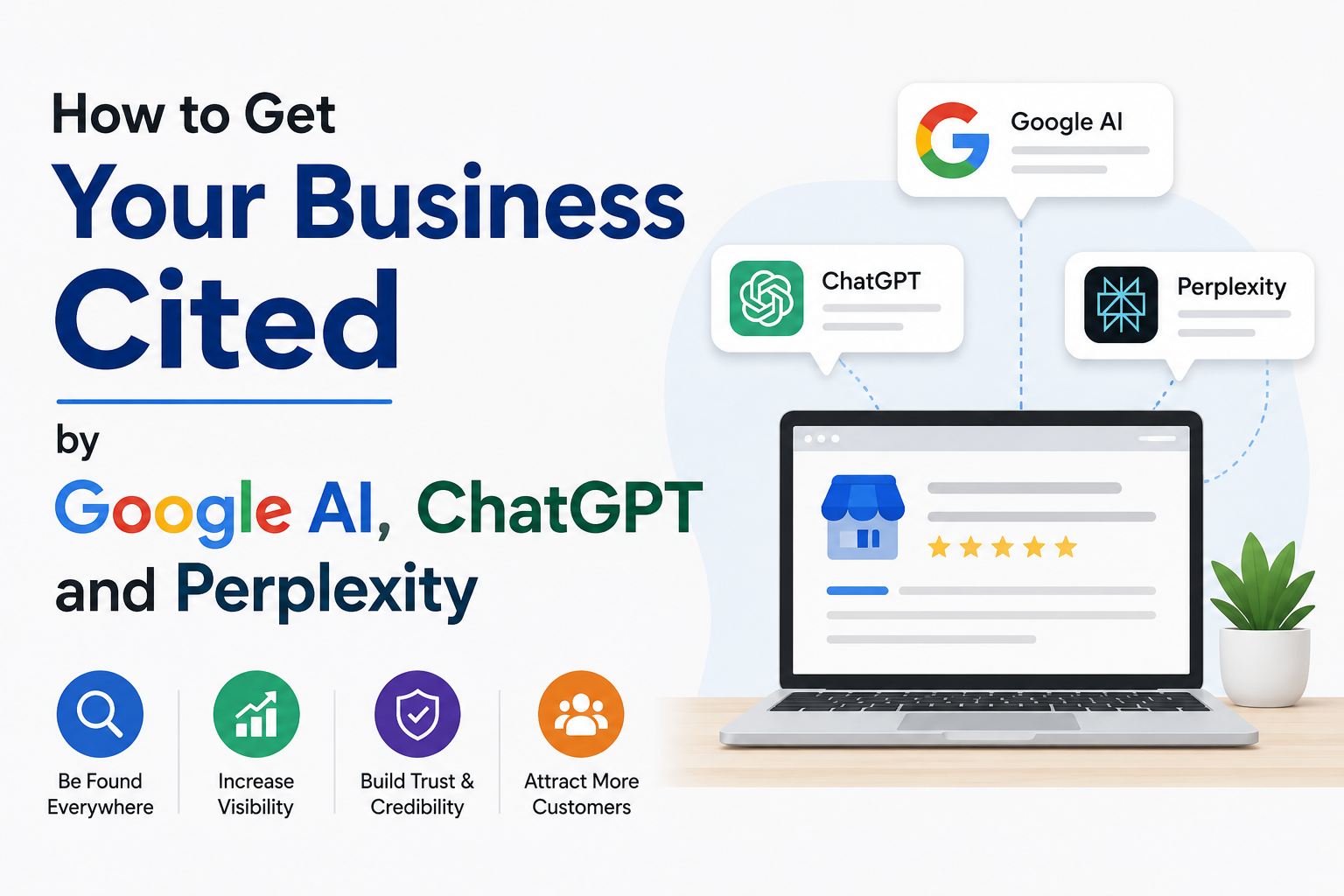
AEO services: Answer Engine Optimisation is the discipline that determines whether your business appears in those AI-generated answers. At Digiwhiz, we have been building AEO and GEO (Generative Engine Optimisation) signals into our clients' content and technical setups for the past 18 months, and we are now offering this as a standalone service for Melbourne and Australian businesses. In this blog, we'll cover what AEO is and how it differs from SEO, the five signals that determine AI citation, the specific steps to optimise for Google AI Overviews, ChatGPT, and Perplexity, and how to measure whether it is working.
What Is AEO and How Is It Different from Traditional SEO?
AEO stands for Answer Engine Optimisation. It is the practice of structuring your content, data, and digital presence so that AI-powered platforms can understand your business accurately, trust it enough to cite it, and surface it when users ask relevant questions.
Traditional SEO is about ranking in Google's organic search results. You target keywords, build backlinks, optimise page speed, and climb the blue-link rankings over time. AEO operates on a different logic. AI platforms do not return ten blue links. Google AI Overviews, ChatGPT, and Perplexity return one answer, or a small set of cited sources. The business that gets cited is not necessarily the one ranking number one in traditional search — it is the one whose content is most clearly structured, most factually specific, and most trusted by the AI model's training and retrieval signals.
The two strategies are complementary, not competing. Strong SEO content that is well-structured, specific, and authoritative tends to perform well in both traditional search and AI citation. But AEO requires specific technical and content elements that traditional SEO does not address, and missing them means your business is invisible in the AI answers your customers are increasingly relying on.
5 Signals That Determine Whether AI Cites Your Business
These are the five core signals that AEO strategy works to build and reinforce.
1. Entity Clarity - AI Needs to Know Exactly Who You Are
AI models build their understanding of your business from structured signals across the web. Your business name, address, phone number, category, and services need to be consistent and clearly structured everywhere they appear: your website, Google Business Profile, Australian business directories, social media profiles, and any media mentions. Inconsistent entity data - different phone numbers across listings, slightly different business name variations, vague service descriptions - makes it harder for AI to confidently identify and recommend you.
2. Structured Data Markup - Schema Is the Language AI Reads
Schema markup is the code layer that tells AI systems directly what your business is, what it offers, where it operates, and what customers say about it. The most critical schema types for Australian businesses are LocalBusiness (or the relevant sub-type for your industry), FAQPage, Service, and Review. Google AI Overviews and Bing Copilot actively use schema to extract information for their answers. Perplexity and ChatGPT use the structured information on your site alongside external sources to build their understanding. Without schema, AI is making inferences rather than reading clear signals - and inferences get you cited less often.
3. Answer-First Content - Structured for Extraction
AI citation engines pull the most direct, most specific answer to the question being asked. Content structured as answer-first paragraphs - a clear direct answer in the first sentence, followed by supporting context - is significantly more likely to be extracted than content that buries the answer in the middle of a long paragraph or uses vague generalisations.
This is why the FAQ structure that has been part of good SEO practice for years matters more than ever in 2026. FAQPage schema combined with answer-first paragraph structure is the most reliable way to build AI snippet eligibility. Every FAQ answer on your website should lead with a single, extractable sentence before expanding.
4. Citation Authority - AI Trusts Sources That Others Trust
AI models are trained on, and retrieve from, sources that are already considered authoritative. A business that is mentioned in reputable industry publications, has a Google Business Profile with strong reviews, is listed in credible Australian directories, and has earned backlinks from trusted websites is treated as more citable than a business whose digital presence is limited to its own website. Building the citation footprint that makes AI trust your business requires consistent digital PR, review management, and structured off-page authority signals.
5. Freshness and Factual Accuracy - Outdated Content Gets Skipped
AI retrieval systems favour current, accurate content. Pages with outdated statistics, outdated pricing, or claims that contradict other sources about your business will underperform in AI citation. For Melbourne service businesses, this means keeping service pages, pricing information, and blog content current and verifiable. Claims that cannot be sourced or verified - vague superlatives, unconfirmed statistics - actively reduce citation probability compared to specific, verifiable facts.
How to Optimise Specifically for Google AI Overviews
Google AI Overviews now appear on a significant share of Australian search queries. Zero-click searches accounted for approximately 58 per cent of all searches in Australia in 2026, up from 51 per cent in 2023, driven significantly by AI Overviews and featured snippets reducing organic click-through rates.
To improve your probability of appearing in Google AI Overviews, the most direct actions are implementing FAQPage schema on every page with a FAQ section, structuring all body paragraphs to lead with the answer rather than the context, ensuring your LocalBusiness or business-type schema is accurate and complete, and targeting informational search queries in your blog content that map to questions your customers actually ask.
Google's AI Overviews draw primarily from sites that already rank in the top ten for a query. This means AEO for Google AI Overviews is not entirely separable from traditional SEO - you need the ranking foundation first, and the AEO structure on top of it.
How to Get Cited by ChatGPT and Perplexity
ChatGPT and Perplexity operate differently from Google AI Overviews. They are retrieval-augmented systems that pull from their training data and from real-time web retrieval, depending on the platform mode and query type. For Australian businesses, the most relevant optimisation approach is:
Publish content that directly answers the questions your target customers ask these platforms. Think about the queries: "best digital marketing agency in Melbourne", "who does Shopify development in Melbourne", "what is AEO and how does it work in Australia." If you have clear, specific, well-structured content that answers these questions better than your competitors, you are building citation probability over time.
Earn mentions in sources that AI models treat as authoritative - industry publications, Australian business media, credible review platforms (Google Reviews, Clutch), and notable web directories. Perplexity's citation model heavily weights sources that appear across multiple independent references. A single well-linked page on your own site is less valuable than consistent mentions across five credible external sources.
Implement an llms.txt file on your website - a plain-text file that tells AI crawlers explicitly what your business does and how it wants to be described. This is an emerging standard that several AEO-forward agencies are now implementing for clients.
How Do You Measure Whether AEO Is Working?
Traditional search ranking reports do not capture AI citation. To measure AEO performance, you need a separate reporting layer.
The most practical approach for a Melbourne small business is monthly manual prompt auditing: run your target queries through ChatGPT, Google AI, and Perplexity, and record whether your business is cited, mentioned, or absent. Track this as a share-of-voice metric over time. Tools like DataForSEO's AI visibility data and HubSpot's AI Search Grader are emerging as more scalable options for businesses with larger query sets.
At Digiwhiz, our SEO services now include AI visibility tracking as a reporting layer alongside traditional organic search performance. This gives clients a complete picture of where they appear across both traditional and AI-driven search channels.
Why Choose Digiwhiz for AEO Services in Melbourne?
Most Melbourne digital agencies are still building traditional SEO strategies and treating AI search as a future concern. Digiwhiz has been integrating AEO and GEO signals into client work for 18 months, which means the businesses we work with are already building the citation authority that competitors have not started on yet.
We are based in Moorabbin, Victoria, with 12 years of experience and more than 500 completed projects. We are an official Google Partner. Our approach to AEO is not a separate product layered on top of your SEO - it is built into everything we do, because the content and technical signals that make Google trust your website are the same signals that make AI platforms cite it.
Find out how we work and what building an AI-visible presence for your Melbourne business looks like in practice.
Key Takeaways
Answer Engine Optimisation is the discipline of getting your business cited by AI platforms like Google AI Overviews, ChatGPT, and Perplexity. With 58 per cent of Australians using AI tools monthly and 12 per cent using them as their primary information source, AI citation is no longer a future concern - it is a current acquisition channel. The five core signals are entity clarity, schema markup, answer-first content structure, citation authority from external sources, and content freshness. Optimising for Google AI Overviews requires combining traditional SEO ranking with AEO structure. ChatGPT and Perplexity citation requires building authority across multiple independent external sources alongside your own structured content. Measuring AEO requires manual prompt auditing and AI-specific tracking tools, not traditional keyword rank reports.
Want to Know How Your Business Currently Appears in AI Search?
The first step is an AI visibility audit: we run your target queries through ChatGPT, Google AI, and Perplexity, document where you appear and where competitors are getting cited instead, and identify the specific gaps in your current setup. There is no obligation after the audit.
Call Digiwhiz on +61 3 9935 6356 or book your free AI visibility audit.